


One Hurts. One Is Strategic
A Strategic Financing Framework for Elevated Rate Environments
ARMs vs TRBs — The Smart Way to Finance in 2026
In today’s rate environment, buyers typically consider three options:
1. Traditional Fixed Financing
2. Traditional Indexed ARMs
3. Temporary Rate Buydowns (3/2/1 TRBs)
These are not variations of the same strategy. They produce very different outcomes.
Understanding how to use a 3/2/1 strategically is what separates reactive financing from disciplined positioning.
Traditional ARMs: Market-Dependent Risk
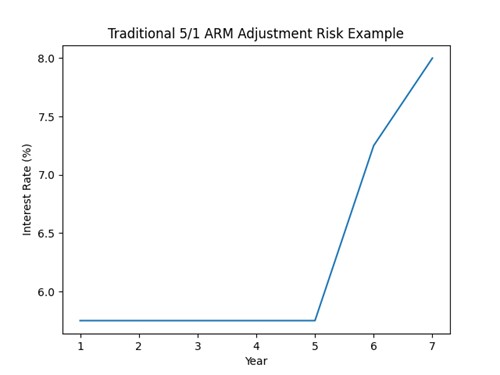
A 5/1 ARM is fixed for five years and then adjusts annually based on a market index.
This means:
– Your future payment depends on future rate markets
– Your rate can increase after the fixed period
– You are exposed to index volatility
The risk is delayed, not removed. If rates rise, your payment rises.
This is reactive financing — dependent on future market conditions.
Traditional Fixed Loans: Stable, But Not Always Strategic
A traditional fixed-rate loan provides stability.
But in elevated rate environments, locking in a higher permanent rate immediately may not be the most strategic move.
It provides predictability, but limited flexibility.
3/2/1 Temporary Rate Buydowns: A Strategic Alternative
A 3/2/1 Buydown is a fully fixed-rate loan.
It is NOT an ARM.
It does NOT adjust with an index.
It does NOT expose you to market volatility.
It simply provides temporary payment relief funded by seller or builder concessions.
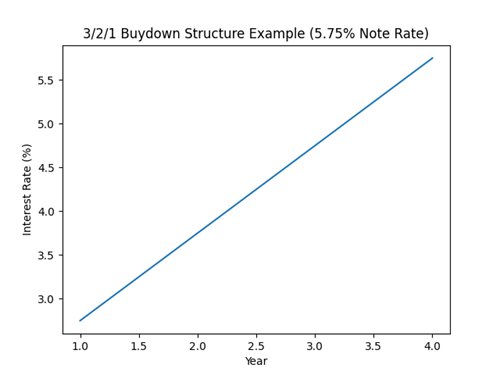
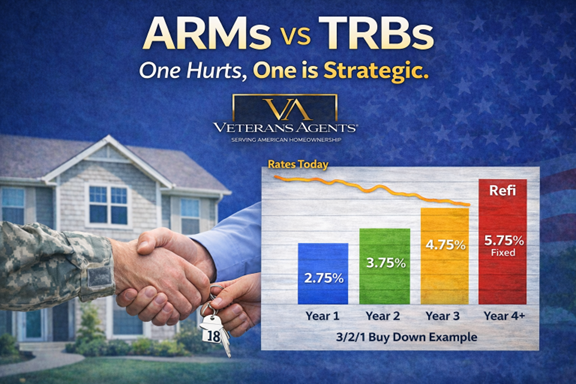
Example using a 5.75% note rate:
– Year 1: 2.75%
– Year 2: 3.75%
– Year 3: 4.75%
– Year 4+: 5.75% fixed
You qualify at 5.75% from day one.
The step-up is predetermined.
There is no market surprise.
This structure is what makes it strategic.
How to Use a 3/2/1 Buydown Strategically
A 3/2/1 is not just about lowering payments — it is about sequencing.
Step 1: Enter Low
You secure the property today, but your effective payment begins at 2.75%.
You preserve liquidity and cash flow during the most important early ownership years.
Step 2: Let Markets Normalize While Your Rate Steps Up Gradually
Your rate increases in controlled steps (2.75 → 3.75 → 4.75).
There is no spike and no index exposure.
Your worst-case scenario is already known: 5.75%.
Step 3: Refinance as Markets Decline
If market rates decline during Years 1–3 — for example into the 4.25%–4.5% range —
you refinance before reaching the full note rate.
This means:
– You entered at ultra-low payments
– You built equity
– You avoided index risk
– You locked a lower long-term rate as markets improved
You never fully experience the higher rate environment long term.
That is strategic positioning.
Why This Is Superior to Traditional ARMs
With a traditional ARM, you hope rates fall before adjustment.
If they do not, your rate adjusts upward.
With a 3/2/1 Buydown, the highest rate you will ever pay is known from day one.
There is no index gamble.
There is controlled downside.
Why This Is Strategic vs Traditional Fixed Financing
If you lock a fixed 5.75% rate today, you begin paying 5.75% immediately.
With a 3/2/1:
– You begin at 2.75%
– You preserve liquidity
– You monitor markets
– You refinance strategically if rates decline
It creates flexibility that traditional fixed financing alone does not provide in elevated rate cycles.

Builder Incentives Are Funding Upgrades and Full 3/2/1 Buydowns
We are currently seeing builders offer significant incentives — in some cases up to $70,000 or more — due to elevated standing inventory.
We know which builders are offering them.
Carrying completed homes costs builders money:
- Construction loan interest
- Taxes and insurance
- Capital tied up in finished inventory
To convert inventory into closings, they are deploying substantial concessions.
In many cases, buyers are not forced to choose between upgrades or financing.
The incentive packages are large enough to cover:
- Structural or design upgrades
- Closing costs
- And a full 3/2/1 Temporary Rate Buydown
That combination is powerful.
You enhance the property.
You reduce early payments dramatically.
You preserve liquidity.
You maintain a fully fixed loan structure.
That is strategic capital deployment — not just a “deal.”
Why This Matters for Military & VA Buyers
Military buyers operate on timelines — PCS moves, promotion cycles, and 3–5 year ownership windows.
VA loans paired with 3/2/1 buydowns:
– Require no down payment
– Allow seller-paid concessions
– Avoid prepayment penalties
– Maintain fixed-rate underwriting
– Preserve refinance flexibility
For service members, this is not just helpful — it is strategic.
Final Takeaway
Traditional ARM:
Index-based. Market-dependent. Reactive.
Traditional Fixed:
Stable. Predictable. Limited flexibility in high-rate cycles.
3/2/1 Temporary Rate Buydown:
Fully fixed. Seller-funded. Super low entry rate. Refinance-positioned. Strategic.
One hurts.
One is strategic.


Cyrus Bonnet | CEO, Broker, Veteran
Est: 2011
Cyrus@veteransagents.com
Verify us:
Reviews: 300+ Reviews
Trustpilot. https://www.trustpilot.com/review/veteransagents.com
Google: https://g.page/r/Ca4OtTQLY67HEB0/review
Zillow: https://www.zillow.com/profile/Cyrus%20Bonnet%20VA%20CSP
📱 Follow us on social media!
Facebook: https://m.facebook.com/veteransAgents/
Instagram: https://www.instagram.com/veteransagents/
YouTube Channel: https://www.youtube.com/@Veteransagents
Important Disclosure
The information provided in this article is for general educational and informational purposes only. I am a licensed real estate professional and not a mortgage lender, loan originator, financial advisor, or legal professional. Nothing contained herein should be construed as financial, lending, tax, or legal advice.
Mortgage products such as Adjustable-Rate Mortgages (ARMs) and temporary buydown programs (including 3-2-1 or 2-1 buydowns) are offered and structured by licensed mortgage lenders and are subject to qualification, underwriting approval, and availability. Interest rates, annual percentage rates (APR), loan terms, and program guidelines are subject to change without notice.
Mortgage rates and loan approvals are influenced by numerous factors, including but not limited to:
• Credit score and credit history
• Debt-to-income ratio (DTI)
• Employment history and income stability
• Loan type and term
• Down payment amount
• Property type and occupancy
• Market conditions and bond market fluctuations
• Lender overlays and risk tolerance
• Seller contributions and closing cost structures
Examples and payment illustrations provided are hypothetical and for illustrative purposes only. They are not a commitment to lend, prequalification, or loan approval.
Prospective buyers should consult directly with a licensed mortgage professional to review their individual financial situation and determine the most appropriate financing strategy.
Equal Housing Opportunity.
Disclaimer:
The information provided in this blog is for general informational purposes only and should not be construed as legal, financial, or professional advice. Real estate laws and regulations can vary by state and situation. You are strongly encouraged to consult with a qualified attorney, real estate professional, or financial advisor before making any decisions or taking action based on the content of this article.